FAQs & RESOURCES
-
Q: What is the Reuse Hub?
Located in Petaluma, California, the Reuse Hub is your home base for reuse, repair, and skill-sharing. We host workshops and community events, provide repair consultations and meetups, and offer affordable secondhand sewing supplies and item rentals through our Creative Reuse store and Library of Things.
Come get all your reuse questions answered, learn new reuse skills and get connected to local reuse resources here at the Hub!
Q: When is the Reuse Hub open?
We are open Wednesdays - Sundays from 12pm - 6pm.
Q: What types of classes and workshops do you offer?
We host a variety of classes and workshops where folks can learn practical reuse and repair skills in a hands-on setting. Our workshops cover all four types of reuse - resale, repair, repurpose, and refill. We teach everything from mending clothes to creative repurposing projects, with all materials provided.
Check out our upcoming workshops here!
Q: Can I teach a class or workshop at the Reuse Hub?
If you have a reuse workshop idea and specialty skills you would like to share with the community, we would love to hear from you! Please fill out this Workshop Proposal form if you are interested in teaching a class at the Reuse Hub.
Q: Do you take item donations?
Yes! We are currently accepting:
Fabric
Yarn
Fiber art tools and supplies (knitting needles, crochet hooks, etc.)
Buttons and other sewing materials
Functional sewing machines
We also ask that all donations meet the following criteria:
Items are clean, dry, unsoiled, with no strong odors
Items are free of infestations and pest damage (for example: clothing moths, mice, bed bugs)
Items are in good condition and usable (please no tangled masses of yarn, etc)
Items are able to be lifted and carried safely by one person
No donations of more than 3 bags without prior approval, please! If you are interested in making a large volume donation, please email us at reusehub@reusealliance.org
If you have item(s) that are not listed above, but you think would be useful at the Reuse Hub please fill out this donation inquiry form and we will get in touch with you. If we are unable to take your donation, we will do our best to help connect you to a local reuse resource that can take your items.
Q: How can I help support the Hub?
There are many ways to support us! The easiest way for you to show your support is by spreading the word about Reuse Alliance and the Reuse Hub to your communities.
Volunteering at the Reuse Hub is another great way to support our mission. Join our wonderful team of volunteers and help out at the Hub by staffing the info desk, helping with workshops, or sorting material donations. We require all first-time volunteers to attend an orientation prior to signing up for shifts.
You could also show your support by becoming a Reuse Hub member! By purchasing an annual membership, you are not only supporting the Reuse Hub and our programs, but you’ll also enjoy benefits including:
10% Discount on a workshop (extra perk: founding members who purchase an annual membership in 2026 will enjoy free access to ALL 2026 workshops!)
Unlimited borrows from the Library of Things
Member News with updates and resources (coming soon)
Discounted space rental
Reuse Awareness Campaign Sticker and Postcards (in person only)
Annual Member Party to celebrate our reuse community
There are also several ways to donate to show your support. Your donation not only helps support our programming at the Reuse Hub, but it also funds advocacy and support for reuse to accelerate the transition to a regenerative circular economy.
-
Q: What is a Repair Fair?
At Repair Fairs, community members can bring in household items for free repair. The item owner will get matched with a volunteer repair coach who will guide them while fixing their item. This hands-on experience empowers them with the knowledge and confidence to tackle future repairs on their own.
Q: Do I have to pre-register to get my item repaired?
While pre-registering is not necessary to attend our events and get your items repaired, pre-registration helps our team prepare for the repair by ensuring we have a volunteer fit for the job as well as all of the necessary tools and parts to fix the item.
Q: Is there anything you can’t fix at the Repair Fairs?
We are unable to repair microwaves, cell phones/tablets, or computers. Repairs that require welding are typically not accepted at our events, but in some cases, we may offer it if the venue permits and we have a volunteer with the necessary experience and equipment.
Q: Are there any additional activities at these events?
Yes! All of our events include additional activities such as a clothing swap, upcycled craft activity, postcard writing, and more.
-
Q: How do I sign up to volunteer as a fixer and what do I need to know?
Sign up for your preferred event date here.
In the sign-up form, you will indicate what kinds of items you are comfortable fixing (e.g. lamps, small appliances, textiles)
Bring the tools you’ll need to fix the item on the day of the event.
Reuse Alliance will send out an informational email the week of the event. There will also be an in-person volunteer orientation prior to opening the doors of the event.
Fix items, educate & empower your community, and create joy!
Q: This is my first Repair Fair as a fixer - what can I expect?First of all, thank you for your interest in volunteering your time and skills at our Repair Fairs!
If this is your first time as a fixer, we ask that you arrive an hour before the event begins to allow ample time for setup and to get acquainted with the other volunteers and Reuse Alliance team. You’ll have your own workstation and access to shared tools, supplies, and parts. You’re also welcome to bring your own tools—especially those commonly used for the type of repairs you signed up for.
The week of the event, we’ll send an email with a list of pre-registered items, giving fixers a preview of the types of repairs they might encounter. This list includes details about each item’s issue and any previous repair attempts, if applicable.
During the event, you’ll be matched with a broken item and its owner. As you work on the repair, we encourage you to explain your approach to help educate and empower the owner to tackle future repairs on their own. Once a repair is complete, we’ll send the next item your way! You can complete as many repairs as possible within the three-hour event.
To keep you fueled, we provide complimentary snacks and beverages for our volunteers—so you can expect to be well-fed while making a difference!
Q: What tools should I bring as a fixer?We recommend our fixers bring tools that are commonly used for the types of repairs you signed up for. We also have a shared toolkit we provide at every event you are welcome to use.
Here are some examples of tools typically used in each type of repair:
Lamps: wire strippers, utility knife, pliers (needlenose & flipjoint), screwdrivers (Phillips & flathead), electrical tape
Small Appliances/Misc: multimeter, soldering iron & solder, utility knife, screwdrivers (Phillips, flathead, & Torx), precision screwdriver set, pliers (needlenose, flipjoint, & locking), adjustable wrench, hex/allen key set, electrical tape, small clamps, superglue/epoxy, contact cleaner, small brush/compressed air for cleaning dust
Textile Mends: needles, sewing machine, thread, embroidery floss, pins/fabric clips, pincushion, seam ripper, measuring tape, fabric scissors, thread snips
Bikes: hex/allen key set, torx wrenches, screwdrivers (Phillips, flathead), pedal wrench
(RA provides a bike stand, pump, lube, and patches/spare tubes, but let us know if you’d like to bring your own!)You can also find a downloadable .pdf file of this tool list sorted by category at the bottom of this page.
Q: Should I bring any parts?Volunteers are not required to provide any parts, but we appreciate their help in identifying what might be needed for specific repairs. The week of the event, we send out the list of pre-registered items, and volunteers can comment on the form if they know which parts may be required for a particular repair. Volunteers are welcome to email the registered attendee directly to ask them to purchase and bring the needed part, or they can ask Reuse Alliance to source and provide the part for the repair.
Q: What happens if I’m unable to fix something?That’s ok! We often encounter repairs that are beyond the scope of our skills. If we are able to diagnose the issue and figure out the next steps, we will share that with the item owner and help guide them to other local repair professionals that can better assist them with their repair.
Q: I want to volunteer, but I don’t feel confident in my fixing capabilities. Are there other things I can help with?Yes! There are several non-fixer volunteer roles at our events. We are always looking for more folks to help out with registration, check out, clothing swaps, craft activities, and more. Check out our upcoming events and volunteer opportunities here.
If you are interested in learning more about repair, volunteering with us is a great way to gain experience. You’re welcome to sign up for a fixer role and partner with a more seasoned volunteer repair coach during the event. You can shadow and assist them while they perform repairs and learn along the way until you feel confident enough to fix items on your own!
-
Q: Why reuse?
We believe that by shifting our mind set from viewing our outputs as waste to viewing them as resources, we will begin to “flip the pyramid”. By thoughtful consumption of our resources (conservation/reduction) and by careful planning of our products, manufacturing and distribution system, we can reuse more than we recycle or compost (rot), with recycling and composting as a final disposition, ideally eliminating the need for landfilling and incineration.Q: What are the benefits of reuse?
Reuse reduces the amount of waste that goes to landfills, conserves resources, saves money, and provides meaningful green jobs. Reusing items also helps make local communities and businesses more resilient, keeping the economy local and reducing the demand for new products from abroad. Reuse provides more jobs per ton than landfilling or recycling. Most importantly, reuse is a mindset, practice, and system of consumption that can lead us out of climate change.Q: What type of items can be reused?
Nearly any type of item can be reused, it requires ingenuity to re-envision just depends on such as clothing, furniture, electronics, appliances, and more. Reusing items is especially beneficial for items that are difficult to recycle, such as foam packaging and electronics.Q: How can I find reuse organizations and companies?
There are many reuse organizations and companies that promote reuse and help to connect people with items they need. You can find local reuse organizations and companies near you by searching online for “reuse near me” or “reuse organizations near me.”Q: Do you have a store?
Reuse Alliance does not, but we consign goods at member sites in Marin and Sonoma County to help support our mission. We currently do not take material donations from the general public. If you’d like to support Reuse Alliance, please consider donating what you can afford. If you have an item to donate, but don’t quite know where to take it, consult your local reuse directory or google. For more information, check out our resources at the bottom of this page.Q: Are Reuse and Recycling the same thing?
Simply put - No. As stated above, Reuse involves the movement of items or materials from one place to another in its existing form, and then using it again. Recycling requires a physical change (and sometimes chemical) in materials, turning them into a completely new item or form. Simple example - a beer bottle can either be reused or recycled. Reuse is a three step process - 1. it moves in a crate from the back of a bar 2. to a washing plant, then 3. back to the brewery for refilling. Recycling a beer bottle is a 6 step process 1. move from the recycling bin 2. to a transfer station 3. to a sorting plant 4. to a crushing plant or machine 5. To the smelter where it is reformed into a bottle 6. back to the brewery for refilling.Q: Is recycling a failure?
No - recycling is a worthwhile pursuit but our society and the environmental movement have allowed a narrative to continue that recycling is the answer to enable our single use and overconsumption based economy. We must rethink what recycling is good for and its place in our society. Recycling should come after all other uses for a material have been exhausted. Again - recycling and composting should be at the end of life of durable goods and materials - the reincarnation of a material into another useful form. We must manage our materials more responsibly. Earth is finite and so are the materials upon this planet. -
View our Community Agreements
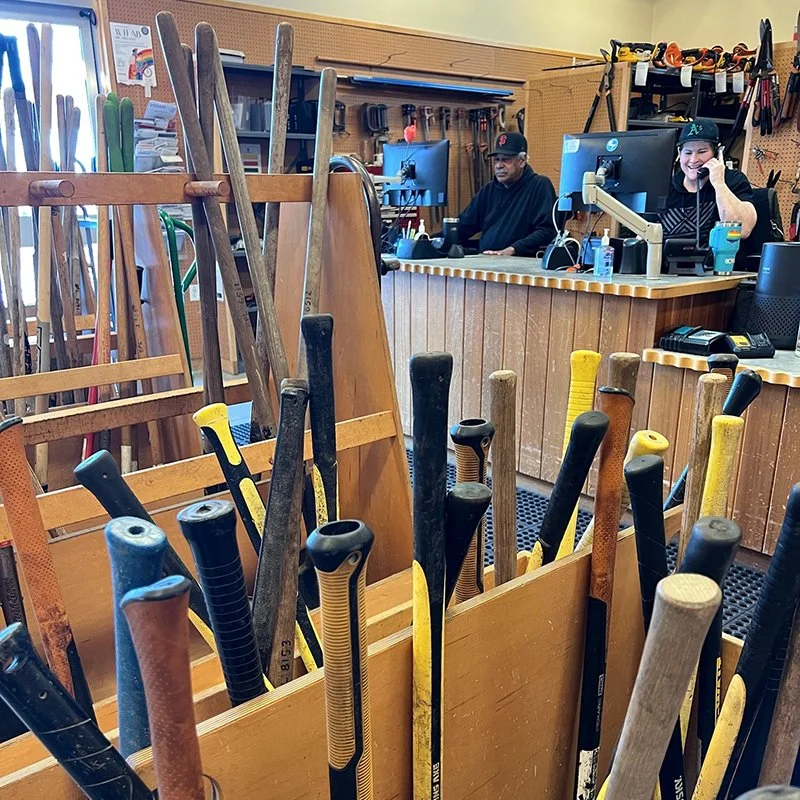
These are the most common tools used at Repair Fairs.